

IELTS Urban Development Vocabulary: Words, Collocations and Expressions for Band 7+

Created by Prepma
Created 3 months ago
Loading guide...
Loading guide...
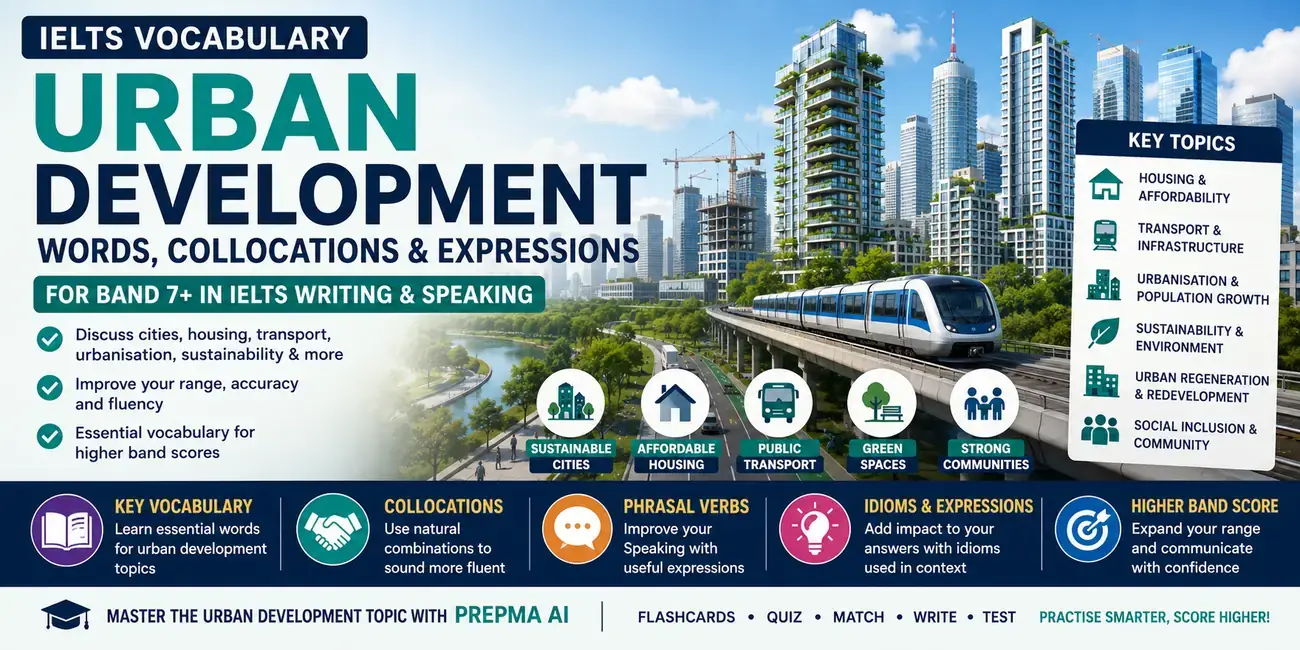
Urban development is a common IELTS topic because it connects with many of the challenges facing modern societies.
In Writing Task 2, you may be asked whether cities should expand upwards or outwards, how governments can reduce traffic congestion, whether historic buildings should be preserved, or how affordable housing can be provided.
You may also need to discuss urbanisation, overcrowding, public transport, pollution, green spaces, social inequality and the effects of redevelopment on local communities.
In IELTS Speaking Part 3, questions may focus on whether cities are good places to live, why people move from rural areas to urban centres, or how cities might change in the future.
To answer these questions effectively, learners need more than basic words such as city, building, road and traffic. They need vocabulary that helps them describe urban problems, evaluate planning decisions and explain possible solutions.
This guide brings together useful vocabulary, collocations, phrasal verbs and idiomatic expressions from the IELTS Urban Development Vocabulary collection on Prepma.
A useful starting point is understanding the basic language used to describe cities and their development.
Urban refers to towns and cities, while rural relates to the countryside. The process through which cities grow or areas are improved can be described as urban development.
A neighbourhood is an area within a town or city where people live. A suburb is usually a residential district outside or near the edge of a city, while the outskirts are the outermost parts of an urban area.
Other useful terms include:
development — the process of building or improving an area
construction — the process of building houses, roads or other structures
residential — relating to areas where people live
community — people living in the same area or sharing common interests
municipality — a town or district governed by a local authority
facilities — buildings, services or equipment provided for a particular purpose
amenities — useful local services such as shops, schools, parks and health centres
masterplan — a comprehensive long-term plan for developing an area
urban renewal — the improvement or redevelopment of neglected urban areas
demolish — to destroy a building, usually to make way for something new
A well-designed urban development should provide housing, transport links and public facilities rather than simply constructing large numbers of buildings.
New residential areas built on the outskirts of cities often lack adequate schools, healthcare facilities and public transport.
Learners who are new to the topic can begin with the IELTS Urban Development Vocabulary for Beginners.
The set introduces the core words needed to discuss urban areas, neighbourhoods, housing, migration and basic city planning. Start with Flashcards to understand the meanings and examples, then use Learn, Match and Test to strengthen recall.
Urbanisation is the process through which an increasing proportion of a country’s population moves from rural areas to towns and cities.
People may migrate to urban centres in search of employment, education, healthcare and improved living standards. However, rapid urbanisation can place serious pressure on housing, transport and public services.
Useful vocabulary includes:
rural-to-urban migration — the movement of people from the countryside to cities
population density — the number of people living within a particular area
overcrowding — a situation in which too many people occupy a limited space
urban expansion — the physical growth of a city
urban sprawl — the uncontrolled outward spread of development
conurbation — a large urban area formed when several towns or cities merge
megacity — a city with an exceptionally large population
rural depopulation — a decline in the population of rural areas
carrying capacity — the number of people an area can support with its available resources
demographic pressure — strain caused by population growth or change
Rapid urbanisation can stimulate economic growth, but it may also overwhelm transport systems, housing supply and sanitation services.
Rural-to-urban migration is often driven by employment opportunities, although migrants may face high living costs and insecure housing after arriving in a city.
Urbanisation should not automatically be presented as either positive or negative. A stronger IELTS response recognises that it can create opportunities while also producing social and environmental pressures.
Housing is one of the most important areas within the Urban Development topic.
Affordable housing refers to homes that ordinary people can reasonably afford to rent or buy. When housing costs rise much faster than incomes, a city may experience a housing affordability crisis.
Useful vocabulary includes:
housing shortage — an insufficient supply of homes
social housing — government-supported housing provided below market prices
rental market — the system through which homes are rented
property speculation — buying property mainly to sell it later for profit
security of tenure — the legal right to remain in a home or use land
homelessness — the condition of having no stable home
informal settlement — housing constructed outside official planning systems
slum — a densely populated area with poor housing and inadequate services
housing stock — all the available homes in an area
mixed-income development — housing designed for residents from different income groups
Increasing the supply of affordable housing can help essential workers remain close to their workplaces and reduce long daily commutes.
Property speculation may contribute to rising prices when homes are treated primarily as financial assets rather than places to live.
Social housing can protect vulnerable residents from homelessness. However, housing programmes must be well maintained and connected to employment, schools and public transport.
Once the basic vocabulary feels familiar, continue with the IELTS Urban Development Vocabulary Intermediate Set.
This set helps learners discuss urbanisation, zoning, housing affordability, social housing, regeneration and sustainability in greater depth.
Transport affects employment, productivity, air quality and the general quality of urban life.
Traffic congestion occurs when there are too many vehicles on the road, causing delays and slow movement. Long periods spent travelling between home and work are often described as a daily commute.
Useful vocabulary includes:
public transport network — the system of buses, trains and metro services in a city
transport infrastructure — roads, railways, stations and other transport facilities
metro system — an urban underground or rapid railway system
commuter — a person who regularly travels between home and work
rush hour — the busiest time of day for traffic and public transport
car dependency — reliance on private vehicles for most journeys
road capacity — the number of vehicles a road can handle
pedestrian zone — an area where vehicle access is limited or prohibited
cycle lane — a designated section of road for bicycles
transport connectivity — the ease with which different places and transport systems are connected
Expanding public transport can reduce car dependency, ease traffic congestion and improve access to employment.
Constructing more roads may temporarily increase road capacity, but it can also encourage additional car use.
A reliable metro system can carry large numbers of commuters efficiently, although it requires substantial investment and long-term planning.
Urban transport questions often require a comparison between private cars and public transport. Avoid simply stating that cars are bad. Explain their convenience as well as their contribution to congestion, pollution and inefficient land use.
The built environment includes the buildings, streets, public spaces and infrastructure created by people.
Good urban planning determines how land is used and how easily residents can access employment, housing, shops and services.
Useful vocabulary includes:
zoning — dividing a city into areas for residential, commercial or industrial use
mixed-use development — combining housing, shops and workplaces within one area
land-use planning — deciding how land should be developed or protected
planning permission — official approval to construct or modify a building
building regulations — rules governing safety, design and construction
high-density development — construction that accommodates many people within a limited area
low-density development — development with fewer buildings and residents over a larger area
compact city — a planning model based on density, mixed land use and public transport
walkability — how safe and convenient an area is for pedestrians
urban design — the planning and appearance of buildings, streets and public spaces
Mixed-use developments can reduce travel distances by placing homes, workplaces and services within the same neighbourhood.
Strict zoning rules may protect residential areas, but they can also limit housing construction and contribute to higher property prices.
A compact city concentrates development within an existing urban area. Supporters argue that this makes public transport more efficient and protects surrounding rural land.
By contrast, urban sprawl spreads development across a much wider area and often increases car dependency.
Compact development may reduce environmental damage, although high-density neighbourhoods must still provide sufficient green space and public facilities.
Urban development has major environmental consequences.
Cities consume energy, produce waste and generate greenhouse-gas emissions. However, good planning can also make cities more environmentally efficient than dispersed settlements.
Useful vocabulary includes:
sustainability — meeting present needs without damaging future generations’ ability to meet theirs
carbon footprint — the total greenhouse-gas emissions produced by an activity or place
carbon-neutral city — a city that balances its carbon emissions with carbon removal or reduction
renewable energy — energy generated from sources such as wind and sunlight
energy-efficient building — a building designed to use less energy
waste management — the collection, treatment and disposal of waste
recycling infrastructure — systems that allow materials to be collected and reused
green building standards — environmental requirements for building design and construction
sustainable transport — transport that minimises environmental harm
environmental impact — the effect of development on the natural environment
Energy-efficient buildings and reliable public transport can substantially reduce the carbon footprint of urban areas.
Sustainable development requires planners to consider environmental and social needs alongside economic growth.
The word sustainable should not be used as a vague synonym for “good.” Explain what makes a particular policy sustainable, such as lower emissions, efficient land use or reduced resource consumption.
Parks, trees and waterways make urban areas healthier and more attractive.
Green infrastructure refers to a connected network of natural features integrated into urban planning. This may include parks, urban forests, wetlands, green roofs and tree-lined streets.
Useful vocabulary includes:
green space — an area of vegetation accessible to residents
urban park — a public park located within a town or city
green belt — protected open land surrounding an urban area
urban forest — trees and wooded spaces within a city
public realm — streets, squares and public areas available to everyone
recreational facilities — places and equipment for leisure or exercise
quality of life — a person’s general wellbeing and living conditions
liveability — how suitable and pleasant a place is to live in
biophilic design — design that incorporates natural elements into buildings and urban areas
urban heat island — the tendency for cities to be warmer than surrounding rural areas
Access to green space can improve physical health, reduce stress and create opportunities for social interaction.
Trees and parks can reduce the urban heat island effect by providing shade and cooling the surrounding environment.
Building on greenfield land may increase housing supply, but it can also destroy habitats and encourage outward urban expansion.
A greenfield site is undeveloped land, while a brownfield site is land that has previously been developed and may be suitable for regeneration.
Urban regeneration is the process of improving a declining or neglected area through investment, construction and economic activity.
Regeneration can restore derelict buildings, create employment and improve infrastructure. However, it may also increase property prices and displace existing residents.
Useful vocabulary includes:
redevelopment — rebuilding or changing an existing area
urban renewal — improving neglected parts of a city
dereliction — the condition of being abandoned and in poor repair
urban blight — visible physical and economic decline in an urban area
brownfield redevelopment — reusing previously developed or industrial land
heritage conservation — protecting buildings or areas of historical importance
revitalisation — bringing new activity and investment into an area
infill development — building on unused land within an existing urban area
adaptive reuse — converting an old building to serve a new purpose
neighbourhood regeneration — coordinated improvement of a local area
Brownfield redevelopment can increase housing supply without extending the city further into surrounding countryside.
Converting former factories into homes or cultural spaces can preserve local character while giving unused buildings a new purpose.
Cities must strike a balance between replacing unsafe buildings and preserving structures with genuine historical or cultural value.
Heritage conservation does not mean that every old building must be protected. A balanced essay can distinguish between buildings of significant value and those that are unsafe or no longer useful.
Gentrification occurs when investment and wealthier residents enter a lower-income neighbourhood, changing its social and economic character.
It may improve buildings, services and safety. However, rising rents and property prices can force long-term residents and small businesses to leave.
Useful vocabulary includes:
displacement — forcing people to leave their homes or neighbourhoods
forced eviction — removing residents without adequate protection or alternatives
rent increase — a rise in the cost of renting a property
property-value increase — growth in the market price of homes or land
social cohesion — the strength of relationships within a community
residential segregation — separation of social or economic groups into different areas
spatial inequality — unequal access to services and opportunities across neighbourhoods
community consultation — involving local residents in planning decisions
right to housing — the principle that everyone should have access to adequate shelter
displacement crisis — widespread loss of housing due to rising costs or development
Urban regeneration can be a double-edged sword because it improves infrastructure while potentially displacing low-income residents.
Policies such as social housing requirements and tenant protection can help existing communities benefit from redevelopment.
When housing is treated primarily as an investment asset, urban development may serve property owners more effectively than residents.
Learners preparing for more sophisticated Writing Task 2 discussions can study the IELTS Urban Development Vocabulary Advanced Set.
The set includes terms such as biophilic design, brownfield development, densification, financialisation, green infrastructure and displacement crisis. Use advanced terms only when they help express an idea precisely.
Cities often contain great wealth and severe poverty within a relatively small geographical area.
A person’s neighbourhood can affect access to education, healthcare, transport, employment and green space.
Useful vocabulary includes:
urban poverty — poverty concentrated within towns and cities
deprived neighbourhood — an area experiencing low income and poor services
informal economy — work and business activity outside formal regulation
social exclusion — being prevented from participating fully in society
economic segregation — physical separation of groups according to income
unequal access — differences in the availability of services or opportunities
marginalised community — a group with limited social or economic power
cycle of poverty — poverty that continues across generations
inclusive development — development designed to benefit different social groups
community resilience — the ability of a community to withstand and recover from difficulties
Investment in deprived neighbourhoods can improve social mobility by increasing access to education, transport and employment.
New infrastructure should not be concentrated only in affluent districts while poorer communities remain underserved.
A strong response does not treat urban poverty merely as a shortage of money. It can also consider poor housing, limited transport, unsafe public spaces and inadequate services.
Rapidly growing cities may struggle to provide adequate water, sanitation, waste collection and drainage.
Useful vocabulary includes:
sanitation infrastructure — systems for safely managing sewage and human waste
waste collection — the organised removal of household and commercial waste
sewage system — infrastructure for carrying and treating wastewater
drainage system — infrastructure that removes excess rainwater
illegal dumping — disposing of waste in unauthorised locations
landfill site — an area where waste is buried
water supply — the system through which clean water is provided
public utility — a service such as water, electricity or gas
service provision — the delivery of essential services
infrastructure deficit — a shortage of necessary public infrastructure
Investment in sanitation infrastructure can improve public health more effectively than treating preventable diseases after they occur.
Poor drainage makes densely populated areas particularly vulnerable to flooding during heavy rainfall.
Cities must increasingly prepare for heatwaves, flooding, storms and other environmental risks.
Urban resilience is the ability of a city to withstand disruption, adapt and recover.
Useful vocabulary includes:
climate resilience — the ability to cope with climate-related threats
flood-resistant infrastructure — infrastructure designed to reduce flood damage
climate adaptation — adjustment to current or expected climate effects
disaster preparedness — planning and resources for responding to emergencies
heat mitigation — measures taken to reduce dangerous urban temperatures
nature-based solution — using natural processes to address environmental problems
water-sensitive design — urban planning that manages water more effectively
resilient infrastructure — systems designed to continue operating during disruption
risk assessment — evaluating potential threats and their consequences
long-term planning — planning that considers future needs and risks
Green roofs, wetlands and urban trees can improve climate resilience by absorbing rainwater and reducing extreme heat.
Local authorities should assess future climate risks before approving major housing or infrastructure developments.
Learning individual words is useful, but natural IELTS answers depend heavily on collocations.
Instead of learning only the word congestion, learn:
ease traffic congestion
reduce traffic congestion
severe traffic congestion
chronic congestion
congestion charging
Instead of learning only the word housing, learn:
develop affordable housing
provide social housing
address the housing shortage
improve housing affordability
increase housing supply
Useful Urban Development collocations include:
rapid urbanisation
unchecked urban sprawl
unplanned urban expansion
high population density
overcrowded urban areas
affordable housing crisis
upgrade informal settlements
prevent forced evictions
manage gentrification pressures
widen spatial inequality
improve transport connectivity
reduce car dependency
expand the metro network
create pedestrian-friendly streets
invest in green infrastructure
preserve historic buildings
regenerate deprived neighbourhoods
revitalise the city centre
improve public amenities
promote sustainable development
reduce the urban carbon footprint
strengthen community cohesion
consult local residents
improve quality of life
City authorities should develop affordable housing and improve transport connectivity rather than allowing unchecked urban sprawl.
Regeneration programmes should revitalise deprived neighbourhoods without displacing long-term residents.
Practise these combinations in the Collocations for IELTS Urban Development Set.
The set contains natural word combinations for discussing urban growth, housing, transport, sustainability, regeneration and social inequality.
Phrasal verbs can make IELTS Speaking answers sound more natural. They should be used selectively in formal Writing Task 2 essays.
To appear or develop suddenly.
Informal settlements may spring up when cities fail to provide enough affordable housing.
To appear unexpectedly, especially when referring to a problem.
Drainage problems often crop up when construction takes place without proper planning.
To demolish a building or structure.
Some authorities tear down old buildings without considering their historical value.
To force people or businesses to leave an area.
Luxury redevelopment can push out long-term residents and independent shops.
To make an area or service too expensive for people to afford.
Rising rents have priced many young families out of central neighbourhoods.
To make a process happen faster.
Digital planning systems may speed up housing approvals.
To delay progress.
Land disputes can hold up infrastructure projects for several years.
To manage or respond to a problem.
Cities must deal with congestion, pollution and housing shortages simultaneously.
To remove waste, pollution or disorder from a place.
The municipality launched a programme to clean up polluted riverbanks.
To connect places or systems.
New bus routes should link up residential areas with railway and metro stations.
To make a place or opportunity more accessible.
A new pedestrian bridge could open up the waterfront to local residents.
Practise the complete list in the Phrasal Verbs for IELTS Urban Development Set.
These expressions are especially useful in Speaking Parts 2 and 3 because they make descriptions of change and development sound more natural.
Idioms can add range to a Speaking response when they fit naturally. They should not be inserted into every answer.
Busy, noisy and energetic city activity.
Some people enjoy the hustle and bustle of city life, while others find it exhausting.
Under so much pressure that failure seems likely.
The public transport network is at breaking point during peak hours.
A point where movement or progress is delayed.
A narrow road has become a major traffic bottleneck near the city centre.
Receive official approval to begin.
The metro extension finally got the green light from planning authorities.
An expensive project that is wasteful or of little practical use.
A poorly planned airport could become a white elephant if passenger demand remains low.
Make something too expensive for many people to afford.
Luxury development can price local families out of the housing market.
A harmful sequence in which problems reinforce one another.
Poor public transport and car dependency can create a vicious cycle of congestion and pollution.
Something with both positive and negative consequences.
Urban regeneration can be a double-edged sword because it attracts investment but may displace existing residents.
Settle in a place and establish a stable life.
Affordable housing allows families to put down roots in their community.
Adapt to modern needs and technologies.
Cities must move with the times by investing in digital services and sustainable transport.
Something that reflects current social or economic conditions.
The growth of co-living developments is a sign of the times in expensive cities.
Find a practical compromise between competing priorities.
Urban planners must strike a balance between development and environmental protection.
Explore more expressions in the Idioms for IELTS Urban Development Set.
One well-chosen idiom can strengthen a Speaking answer. Several forced idioms may make the response sound memorised.
Good vocabulary should help make an argument more precise.
Cities have too much traffic.
Rapid urbanisation and growing car dependency have placed severe pressure on urban transport networks.
Governments should build cheap houses.
Local authorities should increase the supply of affordable and social housing in areas with reliable transport connections.
Old areas should be made better.
Regeneration programmes can revitalise deprived neighbourhoods by improving housing, public spaces and access to employment.
New buildings can harm local people.
Poorly managed redevelopment can displace long-term residents by increasing rents and property values.
The improved versions are not better merely because they contain longer words. They are better because they explain the issue more precisely.
Some people believe that cities should construct more high-rise buildings, while others think cities should expand outwards. Discuss both views and give your opinion.
Supporters of outward expansion argue that suburban development can provide families with larger homes, private gardens and quieter surroundings. Land on the outskirts may also be cheaper, allowing developers to increase housing supply at a lower cost. However, urban sprawl consumes agricultural and greenfield land while increasing car dependency and commuting distances. High-density development makes more efficient use of existing infrastructure and can support reliable public transport. In my view, cities should prioritise carefully planned densification, provided that high-rise neighbourhoods include adequate green spaces, schools and community facilities.
The paragraph uses relevant vocabulary while remaining focused on the argument.
What are the main problems facing cities in your country?
One of the biggest problems is rapid urbanisation. Large numbers of people move to cities in search of work and education, but housing and infrastructure have not always expanded at the same pace. As a result, some urban areas experience serious traffic congestion, overcrowding and high rents. Public transport has improved in several cities, but many residents still depend heavily on private vehicles. I also think the shortage of green space affects quality of life. Better long-term planning is needed so that new housing is connected to transport, schools and public amenities.
The answer combines accessible and advanced vocabulary without sounding unnatural.
Urban describes something connected with a city.
Urban transport systems require long-term investment.
Urbanisation is the process through which the urban population grows.
Rapid urbanisation has increased demand for housing.
Infrastructure refers to essential systems such as roads, railways, water and electricity.
Facilities are buildings or services provided for a particular purpose.
The neighbourhood has good sports facilities but poor transport infrastructure.
Affordable means reasonably priced in relation to people’s incomes.
Cheap simply means low in price and may sometimes suggest low quality.
The city needs more affordable housing for middle- and low-income residents.
Migration is the movement of people from one place to another.
Immigration specifically refers to entering another country to live there.
Rural-to-urban migration is increasing pressure on major cities.
Congestion usually refers to excessive traffic or blockage.
Crowded describes a place containing many people.
The roads are congested, and the trains are extremely crowded.
Renovation usually refers to repairing or improving an individual building.
Regeneration involves the wider improvement of an area or neighbourhood.
The station was renovated as part of a broader urban regeneration project.
Regeneration means improving a declining urban area.
Gentrification describes social and economic change that often occurs when wealthier residents and investment enter a lower-income area.
Regeneration may lead to gentrification, but the terms are not interchangeable.
The Urban Development collection on Prepma contains six focused sets:
Begin with the beginner set and study essential terms related to neighbourhoods, facilities, housing, construction, transport and city growth.
Use Flashcards to understand each term in context rather than memorising only a short definition.
Continue with the intermediate set.
Focus on urbanisation, housing affordability, zoning, regeneration, congestion, sustainability and social inequality.
After studying, choose five words and use them in an answer to this question:
What makes a city a good place to live?
Use the advanced set for topics such as densification, financialisation, green infrastructure, brownfield development, displacement and biophilic design.
Do not force these words into every essay. Use them only when they explain an idea more accurately than a simpler alternative.
Use the collocations set to practise phrases such as ease traffic congestion, reduce car dependency, develop affordable housing and manage gentrification pressures.
Learning complete combinations makes it easier to produce accurate sentences during the exam.
Use the phrasal verbs set to practise expressions such as spring up, tear down, price out, clean up and link up.
These are particularly useful when describing how neighbourhoods change over time.
Study idioms after the core vocabulary and collocations are secure.
Expressions such as hustle and bustle, at breaking point and a double-edged sword can strengthen Speaking answers when used naturally.
Study vocabulary related to cities, neighbourhoods, suburbs, facilities and construction.
Focus on migration, population growth, affordability, social housing and informal settlements.
Study congestion, public transport, zoning, mixed-use development and walkability.
Learn vocabulary connected with green infrastructure, urban renewal, brownfield sites and climate resilience.
Practise natural combinations related to housing, transport, regeneration and sustainability.
Record answers to three Urban Development questions and use selected phrasal verbs and one suitable idiom.
Write one Task 2 introduction and one body paragraph about housing, transport or city expansion.
Knowing the meaning of a word is only the first stage of vocabulary development. IELTS candidates need to recall language under pressure and use it accurately in complete arguments.
The IELTS Urban Development Vocabulary collection on Prepma brings together beginner, intermediate and advanced vocabulary, along with collocations, phrasal verbs and idiomatic expressions.
Learners can start with the core language of cities and housing, progress towards more analytical planning concepts and then practise natural word combinations for Writing and Speaking.
The aim is not to use as many urban-planning terms as possible. It is to choose language that makes an answer clearer, more specific and easier to develop.
Urban development is not only about constructing buildings. It affects housing affordability, travel times, environmental quality, social inequality and the character of local communities.
A strong IELTS candidate should be able to explain why cities grow, identify the consequences of poor planning and evaluate solutions involving housing, public transport, sustainability and regeneration.
Once this vocabulary becomes active rather than merely familiar, it becomes much easier to write balanced Task 2 essays and give confident Speaking Part 3 answers.